

One Registration. Twenty-Seven Countries. The Story Doesn't End There
For any business expanding into Europe, receiving confirmation that its European Union Trade Mark (EUTM) has been registered is a significant milestone. A single registration provides protection across all twenty-seven Member States of the European Union, making the EUTM one of the most efficient trademark systems in the world.
A European Union Trade Mark (EUTM) extends across all 27 EU Member States, including:
• Western Europe: the Benelux (Belgium, Luxembourg, and the Netherlands), France, Germany, and Ireland
• Northern Europe: Denmark, Estonia, Finland, Latvia, Lithuania, and Sweden
• Central Europe: Austria, Czechia, Hungary, Poland, Slovakia, and Slovenia
• Southern Europe: Croatia, Cyprus, Greece, Italy, Malta, Portugal, and Spain
• Eastern Europe: Bulgaria and Romania
It is an achievement worth celebrating.
There is something wonderfully efficient about it: one filing, one registration, and suddenly your brand has a passport to the entire EU. Not bad for a piece of paper that, in practice, can save a company from a great deal of trouble later on.
But for trademark professionals, that milestone marks the beginning of a different responsibility.
Because registering a trademark protects a brand only if that protection is actively maintained. Every week, new trademark applications are published. New businesses enter the market. Existing companies launch new products, refresh their branding, or expand into new industries. Somewhere among those newly published applications could be a mark that deserves immediate attention.
The challenge is no longer obtaining trademark protection.
The challenge is protecting it.
Trademark Watching Has Never Been More Important
Trademark watching has always been an essential part of brand protection. It enables businesses and their representatives to identify newly published applications that may conflict with existing rights, allowing them to take appropriate action within the prescribed timelines.
Over the years, trademark watch platforms have evolved significantly. Official databases, commercial watch services, and digital publication systems have transformed the way trademark professionals monitor brands. Today, they provide comprehensive coverage across multiple jurisdictions and generate timely alerts that make large-scale monitoring possible.
These platforms have become indispensable to modern trademark practice.
However, their success has also highlighted a new operational challenge.
Professionals are no longer struggling to find trademark information.
They are struggling to manage it.
And that is a very different problem. Finding the needle is one thing. Being handed the entire haystack, the barn, and a few extra haystacks for good measure is another.
When More Information Creates More Work
As trademark filings continue to grow, so does the volume of information that professionals must review.
A typical watch report may contain dozens-or even hundreds-of alerts. Some are clearly unrelated. Others appear similar enough to require further investigation. A few may ultimately present genuine legal concerns.
The difficulty lies in determining which is which.
Reviewing these results requires more than simply comparing names. Trademark professionals must consider the overall impression of a mark, the similarity of goods and services, consumer perception, commercial context, and the likelihood of confusion. Every potentially relevant result deserves careful evaluation because overlooking a significant application could mean missing the opportunity to oppose it.
For example, imagine a watch report containing SOLARA, SOLARIA, SOLARIX, and SOLARMAX. At first glance, they all look like they belong to the same family of marks—or perhaps the same marketing department after a very long lunch. But in practice, each one still needs to be assessed carefully. Are the goods identical? Is the visual similarity enough to matter? Does the average consumer notice the difference, or do they just remember "something solar-ish"?
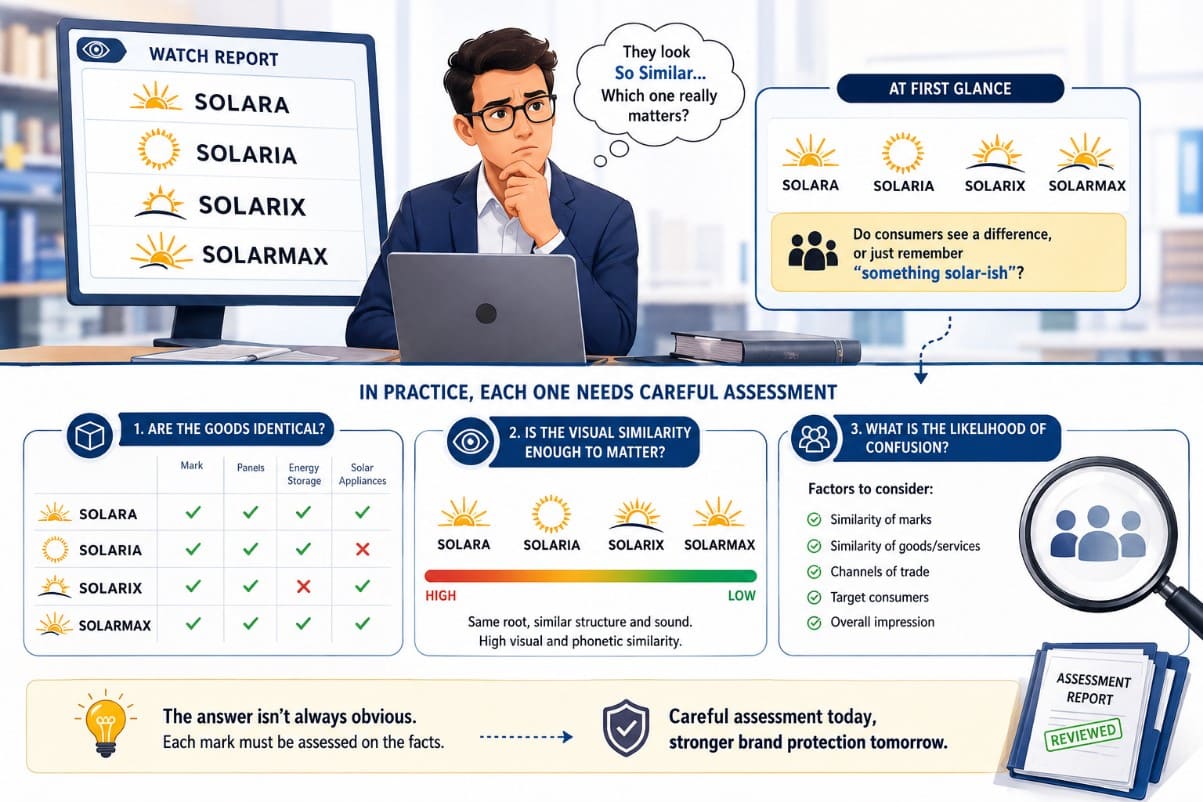
The issue, therefore, is not a lack of information.
It is the growing effort required to analyse that information effectively.
Similarity Is No Longer Limited to Words
Modern branding has evolved far beyond traditional word marks.
Businesses increasingly rely on distinctive logos, stylised lettering, monograms, mascots, geometric designs, and other visual elements to establish their identity. Consumers often recognise these visual characteristics long before they remember the exact wording of a trademark.
This evolution creates additional complexity for trademark professionals.
Two trademarks may contain different words while creating a remarkably similar commercial impression. Likewise, visually similar logos may not share any textual elements, making them difficult to identify through conventional text-based searches alone.
Consider two marks: one is a word mark; the other is a logo featuring a stylised fox wearing sunglasses. The words may be completely different, but if both marks are used for the same goods and services, the visual impression may still raise concerns. And yes, sometimes the fox is the problem.
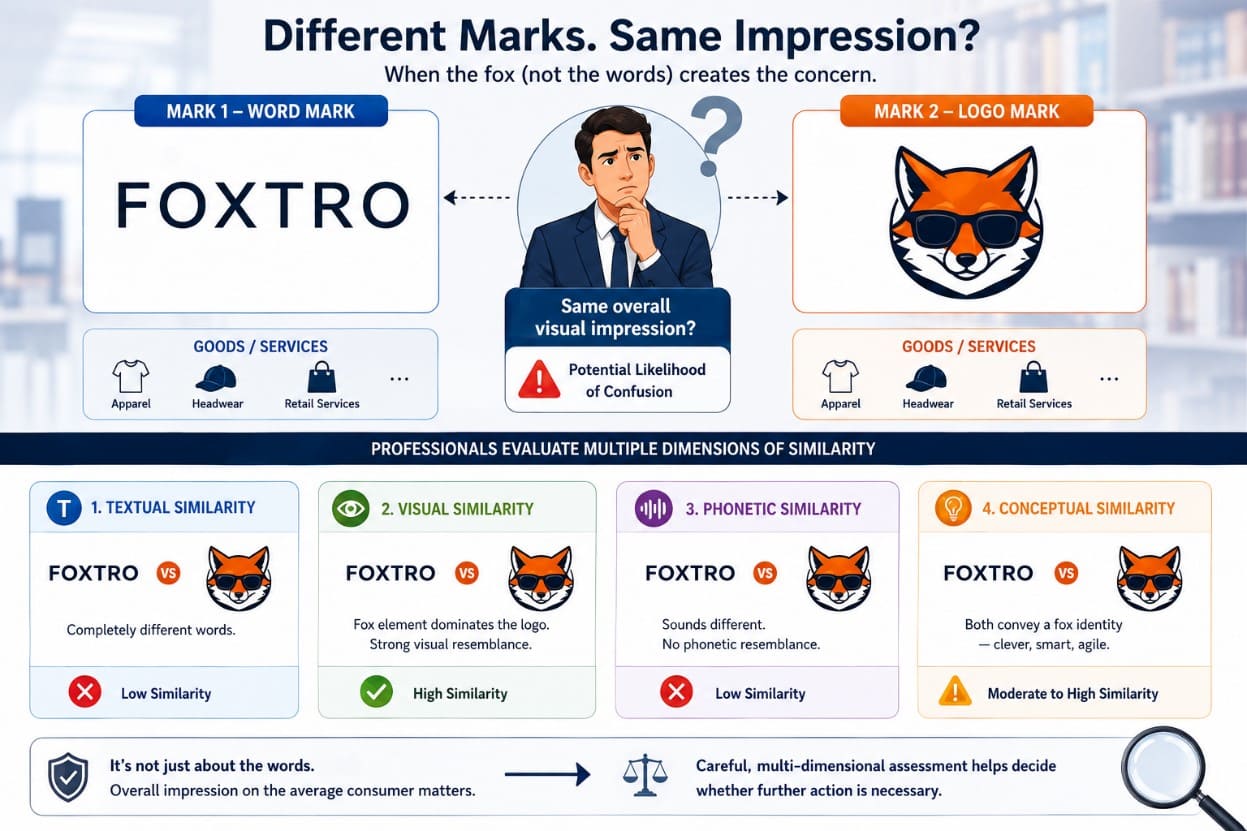
Professionals must therefore evaluate multiple dimensions of similarity, including textual, visual, phonetic, and conceptual aspects, before deciding whether further action is necessary.
This process is both time-consuming and highly dependent on professional expertise.
The Real Challenge Isn't Finding Applications-It's Prioritising Them
Contrary to common perception, today's biggest challenge in trademark watching is not discovering newly published applications.
Modern watch platforms already perform that task exceptionally well.
The real challenge begins after the alerts are generated.
Which applications deserve immediate attention?
Which similarities are commercially significant?
Which results can safely be deprioritised?
These questions cannot simply be answered by generating more alerts. If anything, more alerts often mean more coffee, more scrolling, and more moments of staring at the screen while wondering whether a stylised triangle really is "close enough" to matter.
They require intelligent prioritisation and efficient analysis, particularly for organisations managing large trademark portfolios across multiple jurisdictions.
As filing volumes continue to increase, professionals need better ways to focus their expertise where it creates the greatest value.
Where Artificial Intelligence Adds Value
Artificial Intelligence has become one of the most discussed technologies across industries, including intellectual property. Yet its role in trademark watching is often misunderstood.
AI is not designed to replace trademark attorneys.
Nor can it replace the legal judgement required to assess the likelihood of confusion, interpret commercial context, or develop enforcement strategies.
Those decisions will always depend on experienced professionals.
What AI can do is assist professionals before those legal decisions are made.
By analysing large volumes of trademark data, AI can identify textual, figurative, phonetic, and conceptual similarities more efficiently than traditional review methods alone. Instead of asking professionals to manually examine every alert with equal attention, AI helps surface the applications most likely to warrant closer legal review.
For example, if a watch report contains 120 results, AI can help separate the "probably not relevant" from the "please look at this one immediately" category. That means less time spent on obvious non-issues and more time spent on the matters that actually require legal judgement.
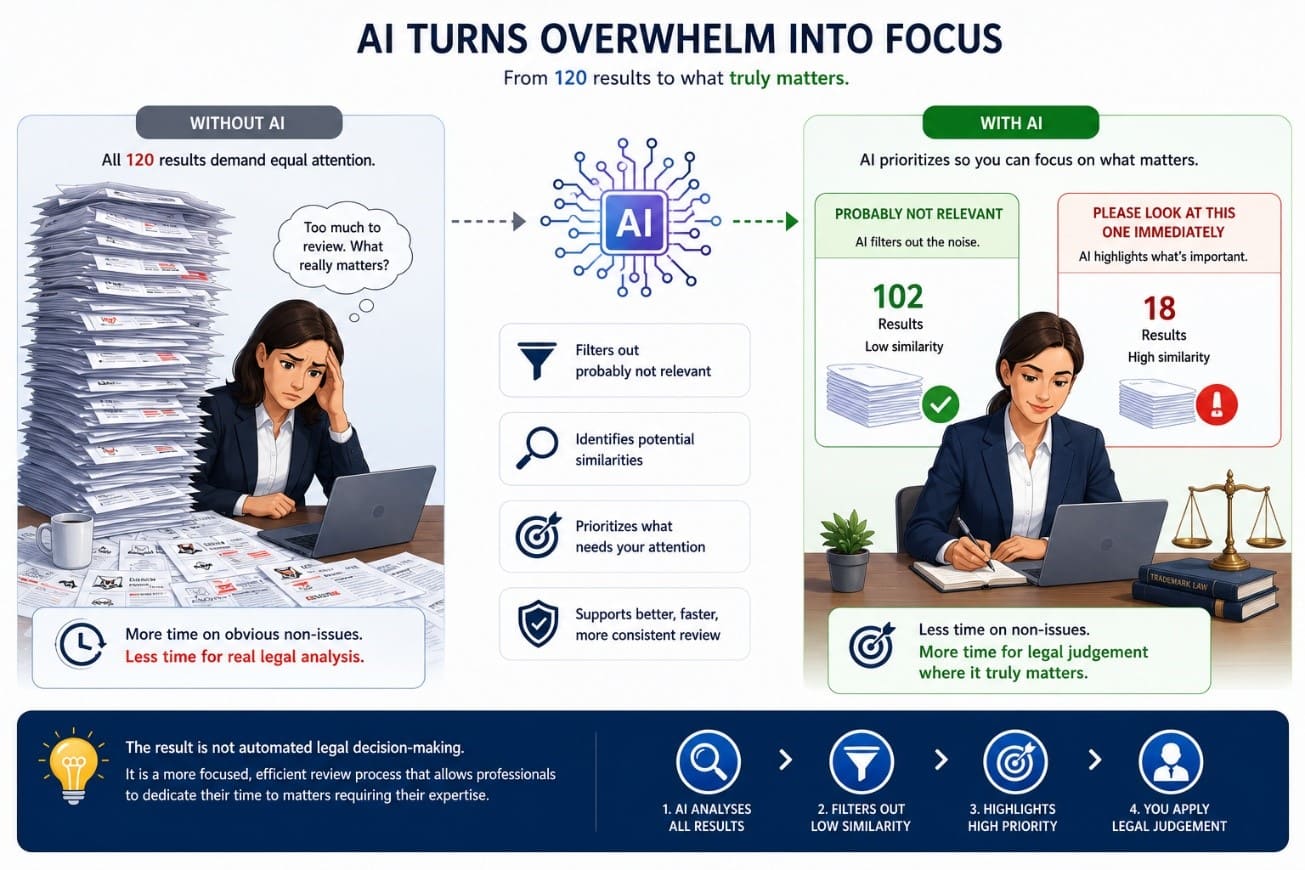
The result is not automated legal decision-making.
It is a more focused, efficient review process that allows professionals to dedicate their time to matters requiring their expertise.
Introducing IOLITE Trademark Watch
This is the philosophy behind IOLITE Trademark Watch.
Rather than replacing existing trademark watch platforms or official databases, IOLITE is designed to complement established workflows by helping professionals work more efficiently with the information they already receive.
Powered by Artificial Intelligence, IOLITE assists in analysing similarities across word marks, logos, monograms, mascot illustrations, geometric devices, and other visual elements, while also considering textual, phonetic, and conceptual relationships. By helping identify meaningful similarities and reducing unnecessary review effort, the platform enables trademark professionals to prioritise the applications that deserve immediate attention.
For organisations managing portfolios across the European Union and multiple international jurisdictions, IOLITE provides a smarter approach to trademark watching-one that supports faster analysis without compromising professional judgement.
The technology assists.
The professional decides.
That distinction matters. AI can help you spot the marks that deserve a closer look, but it will not tell you whether a fox in sunglasses is legally confusing. That part still belongs to the humans.
Looking Ahead
The European trademark system has made obtaining trademark protection more accessible than ever before. The next challenge is ensuring that those rights remain protected in an increasingly complex and data-rich environment.
The future of trademark watching is not about generating more information. It is about helping professionals understand that information more efficiently, identify meaningful risks sooner, and respond with greater confidence.
Artificial Intelligence is becoming an important part of that evolution—not because it replaces expertise, but because it allows expertise to be applied where it matters most.
At IOLITE, we believe trademark professionals should spend less time navigating information overload and more time protecting the brands entrusted to them.
Because one registration across twenty-seven countries is an extraordinary beginning.
The story doesn't end there-it is where brand protection truly begins.
🔗 Click here to learn more about IOLITE Trademark Watch Software